
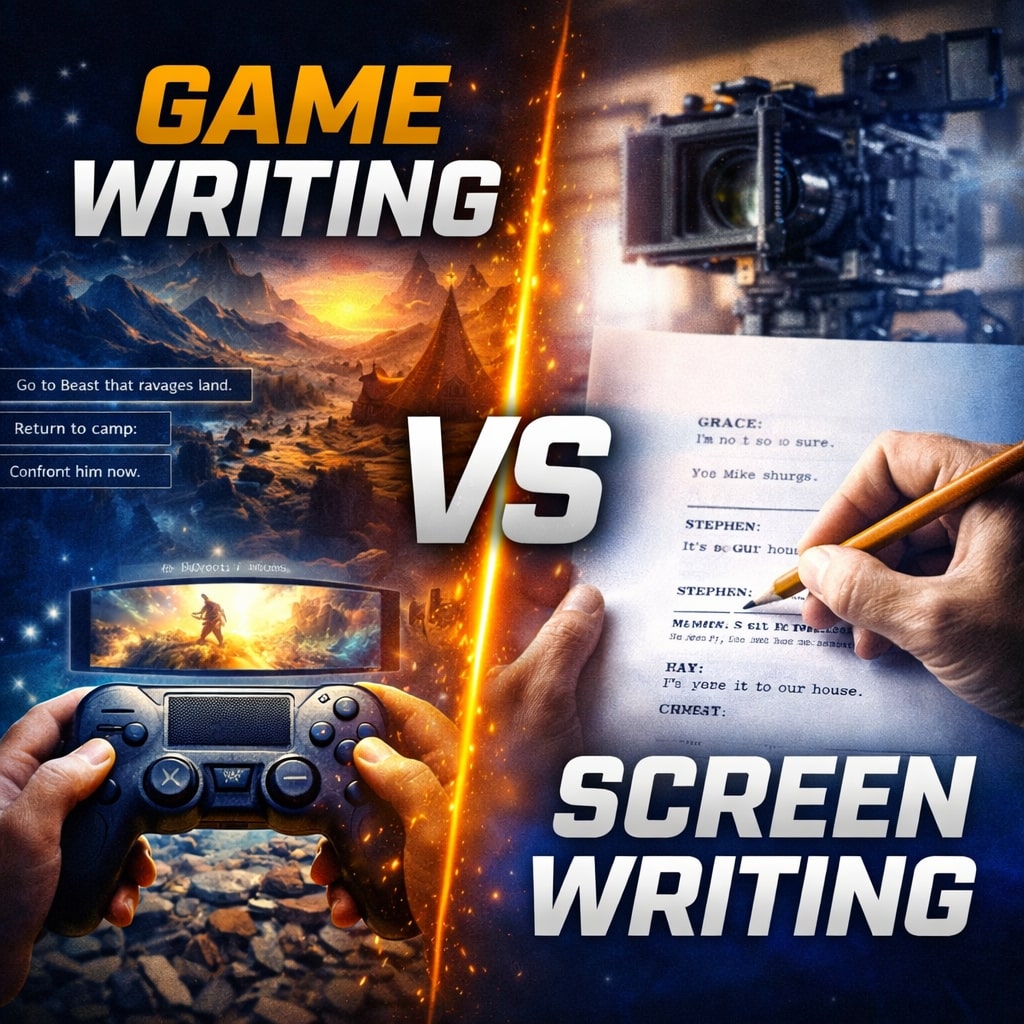
Game writing vs screenwriting is a comparison many writers encounter when deciding where to focus their creative skills. While both disciplines revolve around storytelling, character development, and emotional engagement, they differ fundamentally in structure, audience interaction, and creative control. Understanding these differences is essential for writers looking to work in games, film, or television, or those considering moving between the two fields.
As interactive entertainment continues to grow alongside traditional screen media, knowing how game writing vs screenwriting compares can help writers choose the path that best suits their strengths and long-term goals.
Narrative structure and storytelling approach

One of the biggest distinctions in game writing vs screenwriting lies in narrative structure. Screenwriting follows a largely linear format. The story unfolds scene by scene, with a clear beginning, middle, and end that the audience experiences in a fixed order. The writer carefully controls pacing, reveals, and emotional beats.
Game writing, by contrast, must account for player choice. Stories are often branching, modular, or non-linear, allowing players to influence outcomes through their decisions. This means game writers design narrative systems rather than a single, locked storyline, ensuring the experience remains coherent no matter how players engage with the content.
Audience role: viewer versus participant

Another defining difference in game writing vs screenwriting is the role of the audience. In screenwriting, the audience is a passive observer. They watch events unfold without influencing the story, relying on performances, cinematography, and dialogue to convey emotion and meaning.
In game writing, the audience becomes an active participant. Players do not just witness the story, they drive it forward. Dialogue choices, quest decisions, and gameplay actions all shape how the narrative develops. This interactivity requires game writers to anticipate multiple player behaviours and emotional responses.
Character development and dialogue

Character development in game writing vs screenwriting follows different rules. Screenwriting often focuses on deep, tightly controlled character arcs, with dialogue crafted to serve both plot and performance. Every line is written with timing, delivery, and visual framing in mind.
Game writing must balance character depth with flexibility. Dialogue is frequently non-linear and may be triggered in different orders or contexts. Writers must ensure characters remain consistent and believable even when players approach situations in unexpected ways or skip certain narrative beats entirely.
Collaboration and production pipelines
The collaborative environment is another major factor in game writing vs screenwriting. Screenwriters typically work closely with directors, producers, and editors, but their involvement often decreases once production begins. Scripts may be revised or rewritten by others during filming.
Game writers are embedded in long development cycles, working alongside designers, programmers, artists, and sound teams. Narrative elements are continually tested, adjusted, and rewritten as gameplay systems evolve. This requires flexibility, technical awareness, and a willingness to iterate constantly.
Technical constraints and tools

Technical considerations further separate game writing vs screenwriting. Screenwriters focus primarily on formatting, pacing, and visual storytelling, using industry-standard script formats.
Game writers, however, must understand dialogue systems, branching logic, and narrative tools such as quest editors and localisation pipelines. Writing for games often involves spreadsheets, flowcharts, and scripting tools rather than traditional screenplay software alone.
Career paths and creative fulfilment

Choosing between game writing vs screenwriting often comes down to personal preference and creative goals. Screenwriting appeals to writers who enjoy tightly controlled narratives and cinematic storytelling. Game writing suits those who thrive on collaboration, systems thinking, and interactive storytelling.
Both paths offer rewarding careers, but they demand different skill sets and mindsets. Many writers successfully move between the two, using screenwriting strengths to enhance game narratives and interactive design principles to enrich film and television projects.
Choosing the right path for your writing career
Understanding game writing vs screenwriting is not about deciding which is better, but about recognising what each discipline requires. Writers who enjoy player agency, branching narratives, and long-term collaboration may find game writing more fulfilling. Those drawn to visual storytelling, performance-driven dialogue, and structured narratives may prefer screenwriting.
By understanding these differences, writers can make informed decisions about their creative direction and develop skills that align with the medium they want to work in most.