
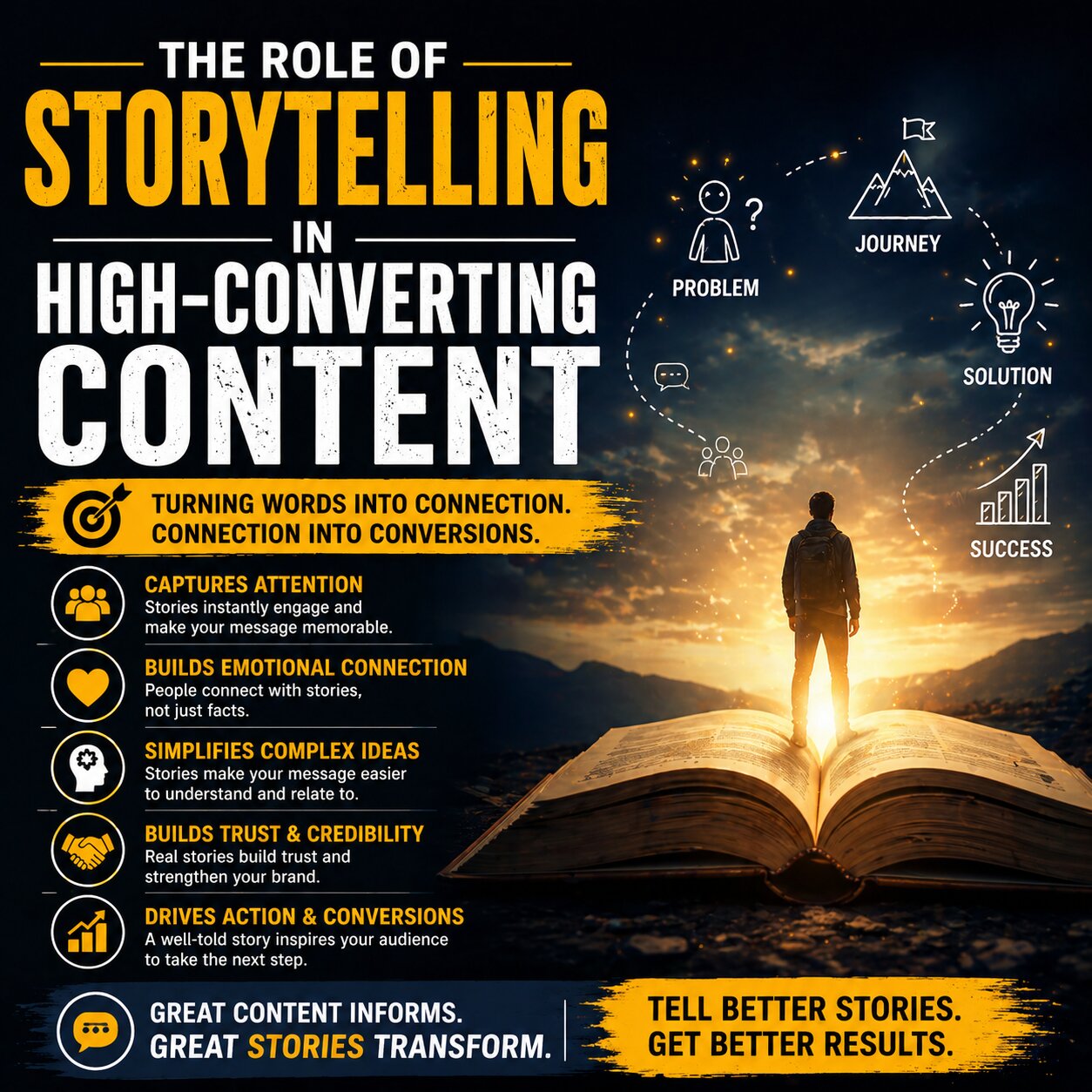
In today’s crowded digital space, facts alone are not enough to capture attention or drive action. Businesses are competing not just on products or services, but on how well they connect with their audience. This is where storytelling becomes a powerful tool in high-converting content.
Storytelling transforms ordinary messaging into something memorable, relatable, and persuasive. Instead of simply telling your audience what you offer, it shows them why it matters, how it solves their problems, and what their journey could look like after choosing your brand.
Why storytelling drives conversions

At its core, storytelling taps into human emotion. People make decisions based on how they feel, then justify those decisions with logic. High-converting content understands this balance and uses storytelling to create emotional engagement first.
When a reader sees themselves reflected in a story, whether through a problem, a challenge, or a goal, they become more invested. They move from passive reading to active interest. This shift is what drives conversions, as the content feels relevant and personal rather than generic and sales-driven.
Storytelling also helps simplify complex ideas. Instead of overwhelming readers with technical details, a narrative can break down concepts into clear, relatable scenarios. This is especially important in industries where services or products require deeper understanding before a purchase decision is made.
Building a story that converts

Effective storytelling in high-converting content follows a clear structure. It is not about creative writing for its own sake, but about guiding the reader through a journey that leads naturally to action.
The story typically begins with a problem your audience recognises. This is followed by tension, where the consequences of not solving that problem become clear. Then comes the solution, where your service or product is introduced as the turning point.
Finally, the story ends with a resolution that shows the positive outcome. This could be improved efficiency, increased revenue, reduced stress, or any benefit that aligns with your audience’s goals. When done correctly, the reader can clearly see themselves achieving that same result.
Key elements of high-converting storytelling
- A relatable audience problem that immediately captures attention
- Clear stakes that highlight what happens if the problem is ignored
- A natural introduction of your solution within the narrative
- Emotional triggers that build trust and connection
- A strong, clear call to action that feels like the next logical step
Applying storytelling across your content strategy

Storytelling is not limited to blog articles. It can be applied across your entire content ecosystem, including website pages, landing pages, email campaigns, and social media posts. The key is consistency in how your message is delivered.
For example, a service page can use storytelling to guide visitors from their pain points to your solution. Case studies can present real-world success stories that build credibility. Even short-form content can include narrative elements that create engagement in just a few lines.
When storytelling is integrated into your strategy, your content becomes more than just information. It becomes a tool that educates, engages, and converts at every stage of the customer journey.
Turning content into connection and action
High-converting content is not about saying more. It is about saying the right things in a way that resonates. Storytelling gives your brand a voice, a perspective, and a way to stand out in a competitive market.
By focusing on your audience’s experiences and framing your message within a compelling narrative, you create content that not only attracts attention but also drives meaningful results. In the end, the brands that tell the best stories are often the ones that win the most trust and conversions.
If you want your content to connect, engage, and convert, storytelling is not optional. It is essential. Contact us if you need some content guidance!