
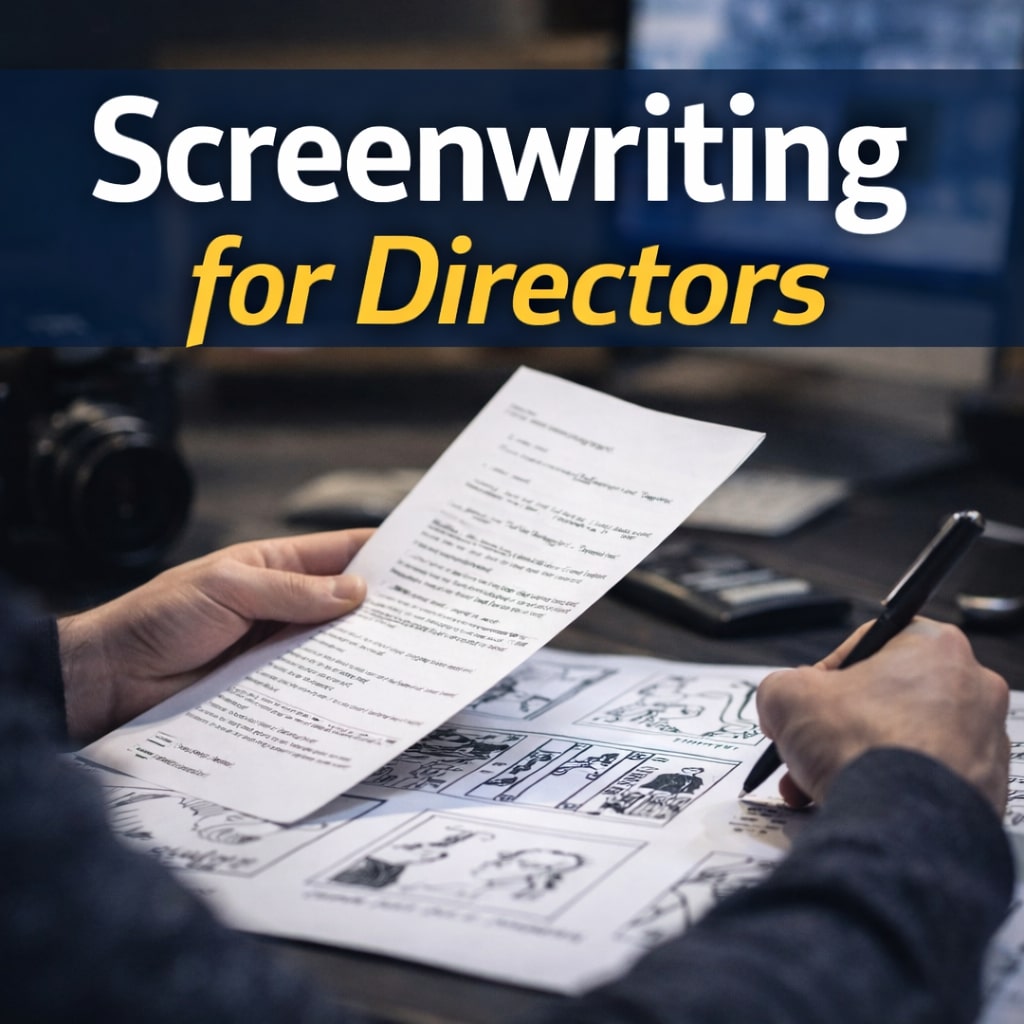
Directors approach storytelling differently from writers who focus purely on the page. For directors, a screenplay is not just a narrative document. It is a blueprint for visual storytelling, performance, pacing, and movement. This is where screenwriting for directors becomes a distinct and powerful skill.
Rather than writing only what happens, screenwriting for directors focuses on how the story will be seen, felt, and executed on screen.
What makes screenwriting for directors different?

Traditional screenwriting prioritises structure, dialogue, and story arcs. Screenwriting for directors goes a step further by considering how scenes will be staged, shot, and edited.
Directors often write scripts with:
- Visual composition in mind
- Clear spatial awareness of scenes
- Natural pacing that supports editing
- Performative subtext rather than exposition
This approach allows directors to communicate their vision clearly to cinematographers, actors, and editors.
Writing visually instead of descriptively
One of the core principles of screenwriting for directors is visual economy. Rather than long descriptive paragraphs, directors focus on concise action lines that imply movement, framing, and rhythm.
For example, instead of explaining emotions in detail, a director-written script may show:
- A character hesitating before entering a room
- A camera lingering on an object
- A silent reaction shot that replaces dialogue
These choices guide the visual language of the film without dictating technical instructions.
Understanding performance on the page

Directors often have a strong understanding of performance, which heavily influences their writing style. Screenwriting for directors tends to leave space for actors to interpret emotions rather than spelling everything out.
This means:
- Less on-the-nose dialogue
- More action-driven emotion
- Clear emotional beats within scenes
By trusting actors, directors create scripts that feel natural and alive on screen.
Pacing, rhythm, and edit awareness
Because directors think ahead to the edit, screenwriting for directors often has a strong sense of rhythm. Scene length, dialogue flow, and transitions are written with timing in mind.
Directors may:
- Use shorter scenes to increase momentum
- Break dialogue with visual actions
- End scenes on visual or emotional hooks
This makes the script easier to translate into a dynamic final cut.
When directors should write their own scripts

Not every director needs to be a screenwriter, but screenwriting for directors is especially valuable when:
- The project is highly personal
- The visual style is central to the story
- Budget or production limitations require precision
- The director wants full creative control
In these cases, writing the script allows the director’s vision to remain intact from concept to final frame.
Common pitfalls in screenwriting for directors
While screenwriting for directors has many strengths, it also comes with challenges. Some common pitfalls include:
- Overwriting camera directions
- Assuming others can “see” the vision without clarity
- Neglecting character depth in favour of visuals
Balancing cinematic thinking with solid storytelling is essential.
Blending writing and directing effectively

The strongest scripts written by directors strike a balance. They are readable, engaging, and emotionally grounded, while still clearly suggesting how the story should unfold visually.
Screenwriting for directors works best when the script serves both the reader and the screen, guiding the production without limiting creative collaboration.
Final thoughts on screenwriting for directors

Screenwriting for directors is about translating vision into a form that others can execute. It blends storytelling, performance awareness, and visual thinking into a single creative process.
For directors who want greater control, clarity, and cohesion in their projects, learning to write with the camera in mind is not just an advantage. It is a creative multiplier.
If you need someone to assist with screenwriting or editing, feel free to contact us. We’ll do our best to help you with your project in any niche you require.