
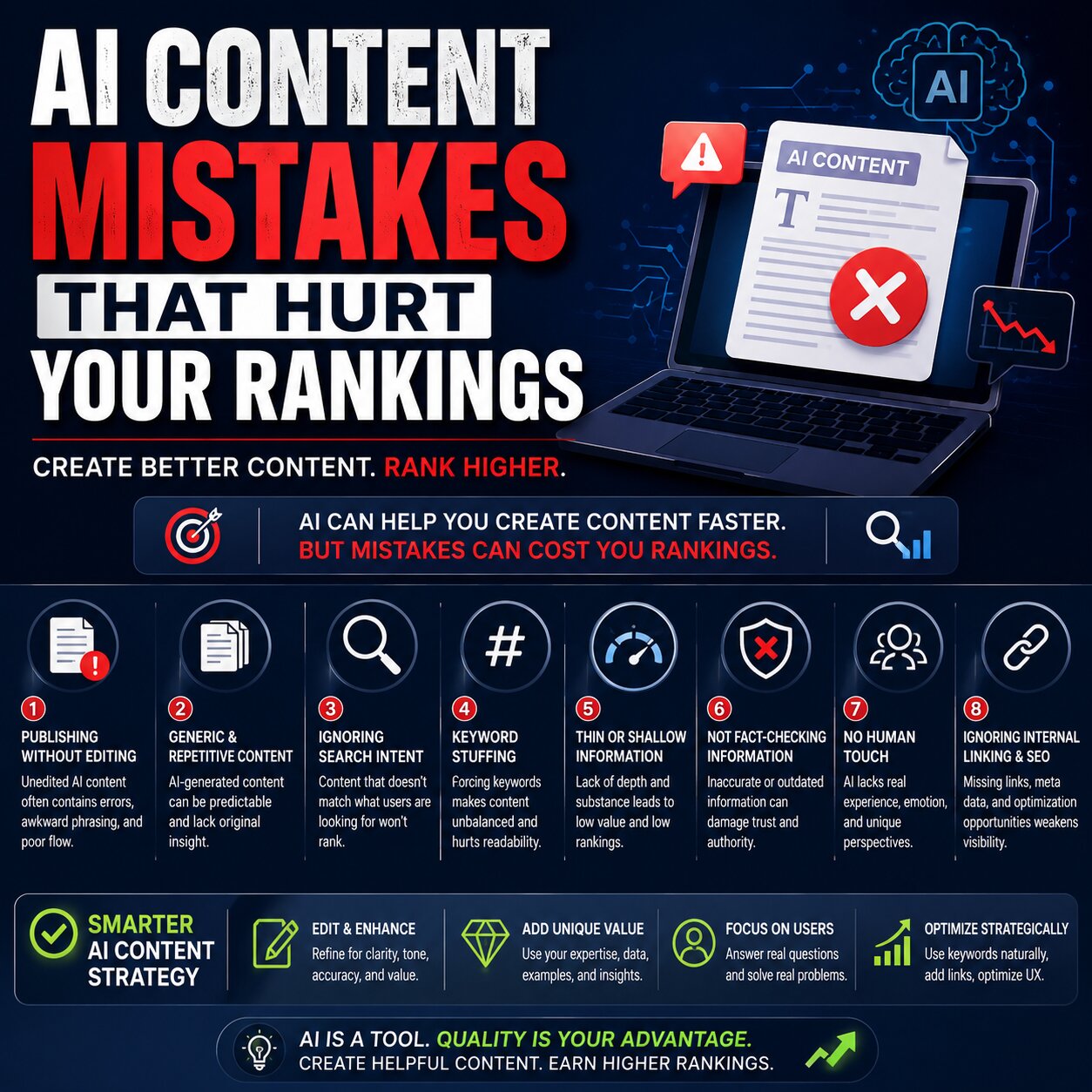
Artificial intelligence has transformed the content industry. Businesses can now generate blog posts, landing pages, product descriptions, and social media content in minutes rather than days. While AI tools can significantly improve productivity, many websites are discovering that poorly managed AI-generated content can seriously damage search engine rankings instead of improving them.
Search engines are becoming increasingly sophisticated at identifying low-quality, repetitive, or unhelpful content. Simply generating large volumes of AI-written text without strategy, editing, or optimisation is no longer enough to compete online. In fact, careless use of AI can lead to weaker user engagement, lower trust signals, and reduced search visibility.
The key is understanding that AI should enhance content creation, not replace quality control, human insight, and strategic SEO practices.
Why search engines prioritise quality over automation

Google and other search engines are not necessarily against AI-generated content. What they care about most is whether content provides value, expertise, originality, and a strong user experience. Websites that use AI responsibly can still perform extremely well in search rankings.
Problems begin when businesses rely entirely on automation without proper editing or strategic direction. Many AI-generated articles suffer from shallow explanations, repetitive phrasing, factual inaccuracies, or generic structure. These issues reduce content quality and make pages less useful for readers.
Search engines also analyse behavioural signals such as bounce rate, dwell time, and user engagement. If visitors quickly leave because content feels robotic or lacks useful information, rankings can decline over time.
Another growing concern is content duplication. AI tools often generate similar sentence structures and predictable phrasing, especially when many websites use the same prompts. This creates oversaturated content that struggles to stand out in competitive industries.
Human expertise, original insights, and authentic experience remain extremely important for modern SEO performance.
Common AI content mistakes damaging SEO performance

One of the biggest mistakes businesses make is publishing AI-generated content without proper review or refinement. While AI tools can create strong drafts, they still require human oversight to ensure quality and relevance.
Keyword stuffing remains another major problem. Some users attempt to force excessive keywords into AI prompts, resulting in unnatural writing that damages readability and SEO performance. Modern search engines prioritise natural language and helpful information over aggressive keyword repetition.
Thin content is also becoming increasingly common. Many AI-generated articles provide surface-level explanations without offering real depth, expertise, or unique perspectives. This is especially dangerous in competitive industries where authoritative content is critical for rankings.
Other common AI content mistakes include:
- Publishing unedited AI-generated articles
- Using repetitive sentence structures
- Creating generic content without originality
- Ignoring search intent
- Failing to fact-check information
- Overusing keywords unnaturally
- Producing thin or shallow articles
- Neglecting internal linking strategies
Another issue involves tone and brand identity. AI-generated content can sometimes feel inconsistent or disconnected from a company’s voice. Strong branding and audience trust rely on maintaining a recognisable style and personality across all content.
Human editing remains essential for successful AI content

The most successful businesses use AI as a support tool rather than a replacement for skilled writers and SEO specialists. Human editing adds nuance, emotional understanding, industry expertise, and strategic thinking that AI alone still struggles to replicate consistently.
Editors can improve structure, refine tone, verify accuracy, strengthen SEO optimisation, and ensure content genuinely satisfies user intent. They can also identify opportunities for deeper insights, case studies, examples, and storytelling elements that improve engagement.
AI tools are particularly effective for research assistance, outlining, brainstorming, metadata suggestions, and drafting content quickly. However, publishing raw AI output without refinement often leads to weaker results in the long term.
Search engines increasingly reward content demonstrating Experience, Expertise, Authoritativeness, and Trustworthiness (E-E-A-T). Human involvement plays a critical role in building those signals.
Businesses that combine AI efficiency with professional editing and strategic SEO practices are far more likely to maintain strong rankings and sustainable growth.
Building smarter AI content strategies
AI content creation is not going away. In fact, it will likely become even more integrated into modern digital marketing workflows over the coming years. The challenge for businesses is learning how to use AI intelligently without sacrificing quality.
A strong AI content strategy starts with understanding audience needs and search intent. Content should answer real questions, provide useful information, and deliver value beyond what competitors offer. AI can assist with production speed, but originality and usefulness must remain priorities.
Companies should also invest in proper content workflows that include research, editing, optimisation, fact-checking, and performance analysis. Publishing fewer high-quality articles often performs far better than mass-producing low-quality AI content.
Regular content updates are equally important. AI-generated pages should not become stagnant. Updating articles with new insights, statistics, examples, and industry developments helps maintain relevance and authority over time.
Ranking Smarter in the AI Era
AI tools offer incredible opportunities for improving content production and efficiency, but they are not shortcuts to guaranteed rankings. Poorly managed AI-generated content can quickly damage trust, engagement, and SEO performance.
Businesses that focus on quality, originality, human expertise, and strategic optimisation will continue to outperform competitors relying solely on automation. The future of successful SEO is not human versus AI, but rather humans and AI working together to create genuinely valuable content.