
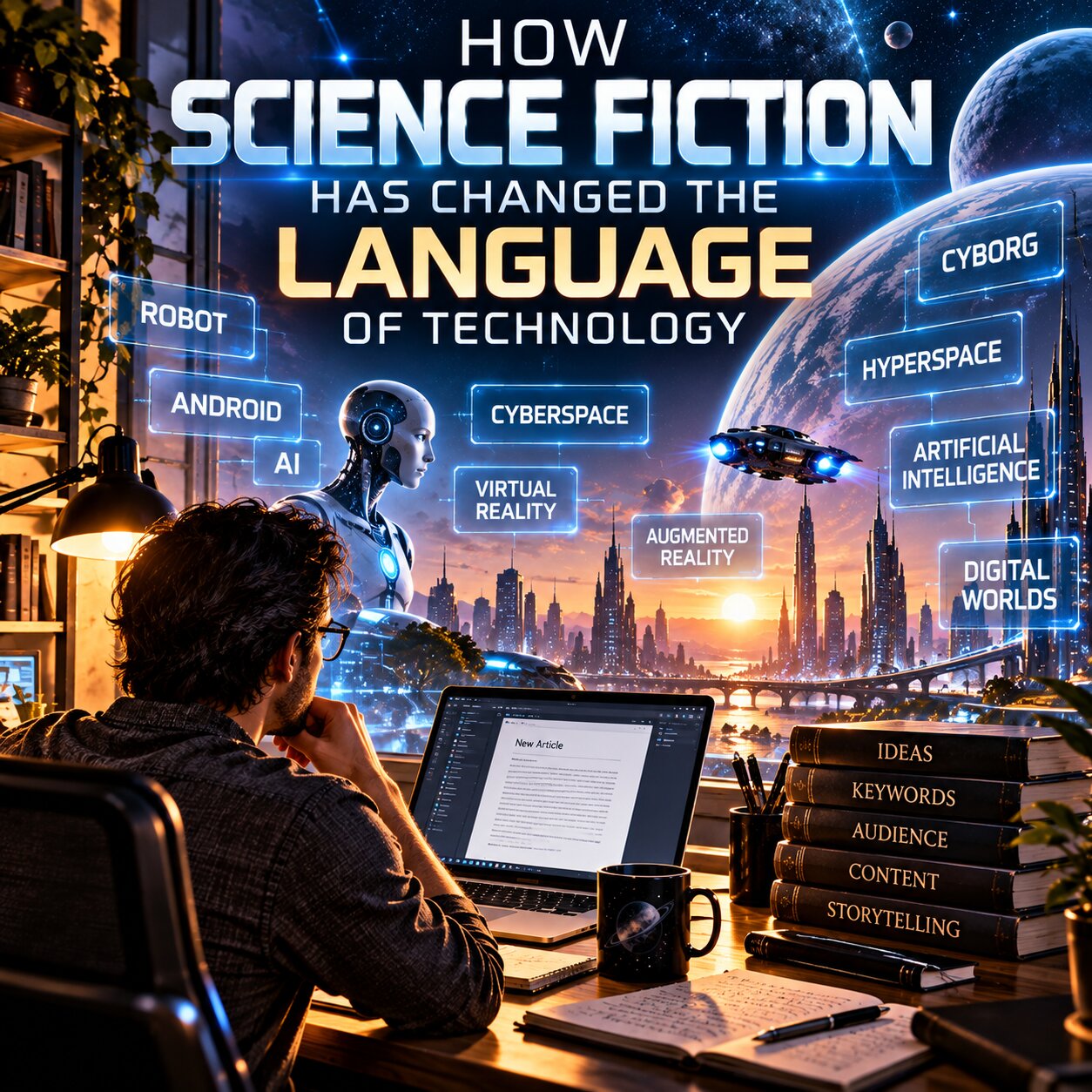
Writers don’t only invent characters and worlds. Sometimes they help give us the vocabulary we eventually use to describe reality.
Science fiction has spent generations imagining technologies that did not yet exist. Authors needed words for intelligent machines, artificial people, strange digital environments and technological concepts their readers had never encountered.
Some of that language eventually escaped fiction.
The word robot, for example, famously entered popular usage through Karel Čapek’s 1920 play R.U.R., although his brother Josef is generally credited with suggesting the term. William Gibson later popularised cyberspace through his fiction, giving readers a memorable way to conceptualise interconnected digital environments.
The relationship works in both directions. Science provides writers with terminology and ideas, while fiction gives technical concepts stories, metaphors and cultural meaning.
When Fiction Gives Writers a Shortcut
This creates an interesting situation for modern content writers.
Mention something behaving “like a robot”, and readers immediately understand the comparison. Describe technology as something from a science fiction film and the audience already has expectations about what that means.
Science fiction has effectively created a shared technological vocabulary.
Terms such as android, cyborg, artificial intelligence, virtual reality and hyperspace can evoke complicated concepts with remarkably little explanation. Not all originated within science fiction, but the genre has played a significant role in embedding many such ideas in popular culture.
That influence matters when writing about emerging technologies.
A company explaining a complicated AI product, for example, needs to balance technical accuracy with language ordinary readers understand. Science-fiction comparisons can sometimes make an unfamiliar concept accessible, but they can also create unrealistic expectations.
Calling an automated system a “robot brain” might sound exciting while completely misrepresenting what the technology actually does.
Good content writing therefore needs to know when futuristic language clarifies an idea and when it distorts it.
The situation becomes even more interesting as technologies once associated with science fiction become commonplace. Artificial intelligence is now discussed in offices, classrooms and homes. Robots operate in factories and other environments. Virtual environments have become consumer products.
Content writers consequently face a fascinating challenge: explaining technology that readers may already believe they understand because they have encountered fictional versions of it for decades.
Tomorrow will undoubtedly bring new terminology.
Some will come from laboratories and technology companies. Some may emerge naturally through popular culture.
And somewhere, a science fiction writer may already have invented the perfect word for something humanity hasn’t built yet.
If you’re that fiction writer, Celenic Earth Publications welcomes science fiction manuscripts for consideration. submit your sci fi book here.