
For years, businesses creating online content largely understood the basic objective. Produce useful material, optimise it appropriately for search engines, establish authority and persuade readers to take the next step.
That formula isn’t disappearing, but something significant is being added to it.
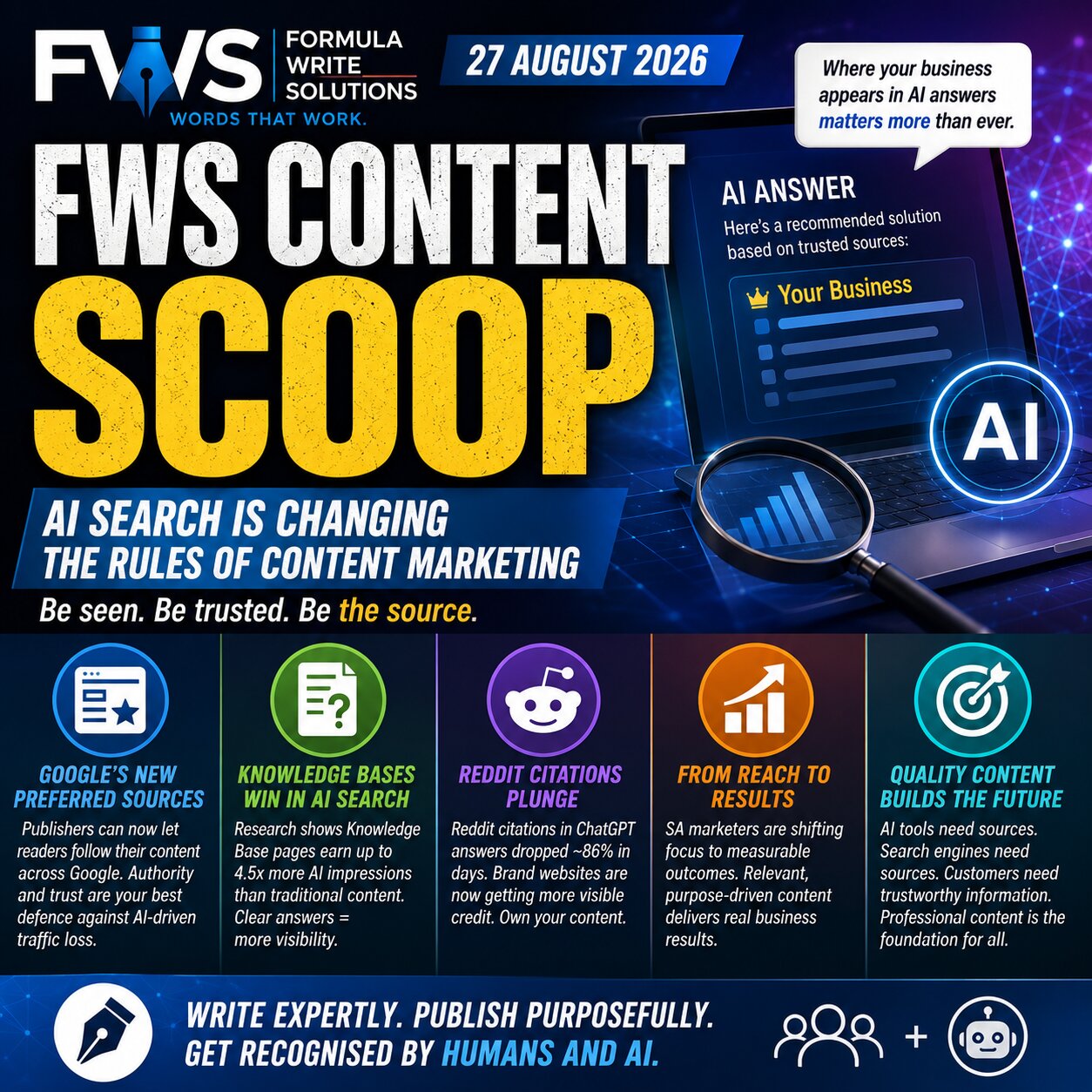
Search engines increasingly provide AI-generated answers, consumers are asking conversational AI systems for recommendations, and brands are beginning to care about whether their names appear inside those responses. At the same time, Google is giving publishers new tools to retain visibility, research is suggesting certain types of authoritative content perform particularly well in AI search, and South African marketers are being pushed towards measurable results rather than simple reach.
Welcome to a content landscape where being read remains important, but being recognised as a trustworthy source may become equally valuable.
Google Gives Publishers a New Weapon Against Falling Traffic
One of the most interesting developments for content publishers arrived from Google.
Google has introduced an embeddable Preferred Sources button that publishers can place directly on their websites. Readers can use it to indicate that they want to see more content from that particular source across areas of Google’s ecosystem.
The feature could help publishers fight some of the traffic pressure created by AI-powered search.
That pressure has become increasingly difficult to ignore.
When Google provides an AI-generated response directly on its results page, users may obtain the information they need without visiting the website responsible for supplying or supporting that information.
For businesses investing in professional content, this changes the equation.
Ranking highly still matters, but establishing a recognisable and trusted publishing presence becomes increasingly important too. A business wants readers to remember who provided the expertise, rather than simply consuming an answer and disappearing.
That makes branding, authority and consistently useful content more important, not less.
Knowledge Bases Could Become Powerful AI Visibility Tools
Traditional blog articles aren’t the only content businesses should be considering.
New research reported by Arc Intermedia suggests that structured Knowledge Base content may perform particularly well in generative AI results.
Across four websites included in the research, 62 Knowledge Base URLs generated 147 citations in monitored AI prompts. One participating brand reportedly achieved 4.5 times more generative AI impressions per Knowledge Base URL than it received from conventional website content.
The findings don’t mean every business should suddenly transform its website into a giant FAQ.
They do, however, reinforce something professional content writers have understood for years: clear answers to specific customer questions are extremely valuable.
Businesses should think carefully about content answering questions such as:
- What does this product or service actually do?
- How does the process work?
- What problem does it solve?
- How does one option compare with another?
- What should customers know before making a decision?
Those questions closely resemble the prompts people give conversational AI systems.
The businesses publishing the clearest, most credible answers therefore have an opportunity to become sources those systems recognise.
Reddit Citations Collapse — and Brand Websites Could Benefit
Another fascinating development illustrates just how quickly AI visibility can change.
Industry monitoring detected an enormous decline in Reddit citations appearing in ChatGPT responses during August. According to Promptwatch data reported by Business Insider, visible Reddit citations dropped by approximately 86% during a matter of days.
That doesn’t necessarily mean Reddit suddenly became irrelevant.
Research suggests AI systems may still consult Reddit content while changing which sources they visibly credit.
What makes this particularly interesting for businesses is the suggestion that brand-owned websites may now be receiving more visible attribution.
For marketers, the lesson isn’t to chase whichever platform an AI model appears to favour this week.
It is almost the opposite.
Algorithms change.
Platforms change.
Citation behaviour changes.
A company’s website remains one of the few digital assets it actually controls.
Building a substantial library of original, useful and authoritative content on that website therefore remains one of the strongest long-term investments a business can make.
South African Media Moves From Reach Towards Results
The transformation isn’t limited to AI search.
South Africa’s media industry is also becoming increasingly focused on measurable outcomes rather than simply enormous audience numbers.
Media fragmentation means consumers are spread across social networks, search engines, streaming services, websites, podcasts, creator platforms and countless smaller digital communities.
As The Media Online recently observed, relevance and engagement are becoming more important as advertisers demand stronger accountability and clearer returns from their marketing investment.
That has consequences for content writing.
A business article that attracts 500 genuinely relevant potential customers may ultimately deliver more commercial value than generic viral content viewed by 50,000 people with no interest in purchasing anything.
Effective content therefore needs a purpose.
Traffic matters.
But so do enquiries, leads, authority, conversions and long-term brand recognition.
Around the Content and Marketing World
Google’s August spam update has also placed content quality under renewed scrutiny, reinforcing the importance of publishing material created to genuinely help users rather than manufacturing pages purely to manipulate rankings.
At the same time, Google Search Console is providing marketers with more information about generative AI visibility, giving website owners additional ways to understand how their content performs beyond conventional blue-link search results.
The advertising landscape is evolving too.
Conversational AI is increasingly moving closer to the point where consumers make purchasing decisions. Instead of searching for a list of products and comparing ten websites themselves, people can ask AI systems to compare features, explain differences and recommend appropriate options.
That creates an entirely new competitive battleground.
Businesses won’t simply be asking:
“Can customers find us on Google?”
Increasingly, they’ll also need to ask:
“Does AI know enough about our business to recommend us?”
The answer may depend heavily on the quality of the information businesses publish about themselves.
The FWS View: Professional Content Matters More, Not Less
There has been a persistent assumption since generative AI became mainstream that professional content writing would eventually become unnecessary.
The evidence increasingly points towards a very different future.
Businesses need authoritative information online precisely because machines are becoming involved in how people discover, research and compare products and services.
AI systems require sources.
Search engines require sources.
Customers require trustworthy information.
A company with thin service pages, outdated information and generic automated articles gives both humans and machines very little reason to consider it authoritative.
A company that consistently publishes detailed, accurate and useful material creates an entirely different digital footprint.
The tools may be changing, but the fundamental purpose of content remains remarkably familiar.
Answer people’s questions.
Demonstrate expertise.
Build trust.
Help customers make informed decisions.
Professional content isn’t becoming obsolete.
It is becoming the foundation from which both humans and AI learn what a business knows.