
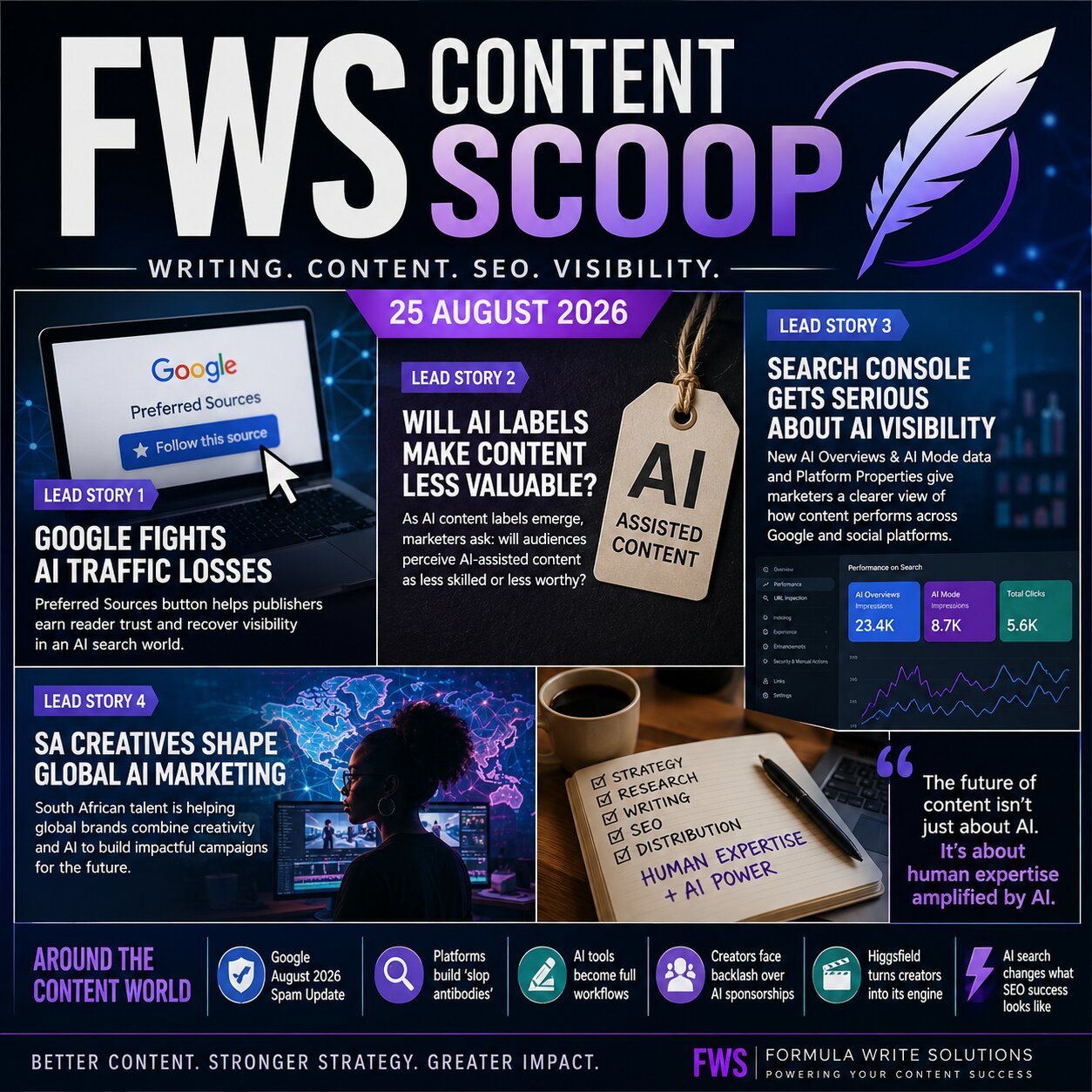
Welcome to the FWS Content Scoop for 25 August 2026, covering the developments shaping professional writing, SEO, content marketing and digital visibility.
Today’s biggest stories revolve around a problem that increasingly affects anyone producing content online: AI is changing not only how content is created, but how audiences discover and value it.
Google has introduced another tool designed to help publishers recover some of the traffic disappearing into AI-powered search, while marketers are beginning to ask whether visible AI labels could change what audiences believe content is worth.
Meanwhile, Google Search Console is becoming considerably more useful for measuring AI visibility, and South African creatives are making their presence felt within global AI-powered marketing.
Lead News: Google Gives Publishers Another Weapon Against AI Traffic Losses
Google is giving publishers a new way to encourage readers to choose their websites as trusted sources as AI-generated answers continue disrupting traditional search traffic.
Publishers can now embed a Preferred Sources button directly on their websites. Readers selecting it can indicate that they want to see more content from that publication across Google Search, Discover and Google News.
Google says people are around twice as likely to click through to a preferred source when it appears in their results.
That matters because the economics of online publishing are increasingly being challenged by AI search.
AI Overviews and similar features can provide users with answers without requiring them to visit the websites responsible for producing the underlying information. Recent experimental research involving 1,100 Google Search users found that removing AI Overviews and AI Mode increased click-through rates to publishers.
For businesses investing in content marketing, this changes the objective.
Ranking well remains valuable, but building a recognisable publication or brand that readers actively choose to follow and trust could become increasingly important as search engines provide more answers themselves.
The content industry may therefore be moving from simply fighting for rankings towards fighting for something considerably more valuable: reader preference.
Read the TechCrunch report on Google’s Preferred Sources tools
Lead News: Will AI Labels Make Content Less Valuable?
Marketers are confronting another consequence of generative AI adoption: what happens when audiences can immediately see that content was created using AI?
As platforms and technology companies experiment with watermarking and AI-content identification, agencies and brands are considering how those labels might influence audience perceptions.
The problem isn’t necessarily whether AI was involved.
Modern content workflows increasingly combine human creativity with AI tools for research, ideation, editing, imagery, optimisation and production. The question is whether audiences interpret an AI-generated or AI-assisted label as evidence that the content required less skill, effort or financial investment.
That could create a difficult commercial situation.
If clients begin assuming AI-assisted content should automatically cost less, professional writers, designers and agencies may have to become much clearer about what they’re actually selling.
The value of professional content has never simply been the number of minutes required to type it.
Strategy, research, subject knowledge, accuracy, brand voice, editing, audience understanding and accountability all contribute to the finished product.
AI may reduce production time, but it doesn’t necessarily remove those requirements.
For content professionals, demonstrating the human expertise surrounding the technology could become just as important as demonstrating the final result.
Read more about how AI labels could affect content value
In Other News: Google Search Console Gets Serious About AI Visibility
SEO professionals are finally getting more visibility into what happens inside AI-powered search.
Google Search Console has begun separating impressions generated through AI Overviews and AI Mode from traditional search performance, giving publishers and marketers a clearer picture of whether their content is appearing within Google’s generative experiences.
Google has also introduced Platform Properties, allowing brands and creators to track how content from platforms including YouTube, TikTok, Instagram and X performs within Google Search and Discover.
That’s an important development for content strategy.
SEO is increasingly moving beyond optimising individual website pages. Videos, social posts and other distributed content can contribute to search visibility and may also appear within AI-generated responses.
For content writers and marketers, measurement therefore needs to evolve alongside search itself.
Traditional rankings and clicks still matter, but AI appearances, citations, social visibility and brand recognition are becoming additional pieces of the SEO puzzle.
Explore the latest Google Search Console and AI visibility developments
In Other News: South African Creatives Help Shape Global AI Marketing
South African creative talent is playing an increasingly visible role in the global transition towards AI-assisted marketing.
Women working within Brandtech+’s South African operations are among those helping international brands integrate generative AI into creative production.
The work involves combining traditional creative skills with emerging technology rather than simply replacing creative professionals with automated systems.
That’s an important distinction for South Africa’s writing and marketing industries.
AI makes it theoretically possible for agencies anywhere in the world to compete internationally, but access to the same technology doesn’t automatically produce the same results.
Creative judgement, cultural understanding, strategy and storytelling remain differentiators.
For South African writers, designers and marketers, that creates an opportunity to compete internationally without abandoning the human expertise that made creative services valuable in the first place.
Around the Content World
Google releases its August 2026 spam update — Search marketers are watching rankings closely following Google’s latest spam-fighting update, another reminder that low-value and manipulative content remains firmly in the search giant’s sights. Follow the latest Google SEO developments at Search Engine Land
Platforms are developing “slop antibodies” — Search and social platforms are developing more ways of identifying commodity AI content, increasing the importance of originality and genuine expertise. Read the latest content marketing coverage
AI tools are becoming entire content workflows — Content teams increasingly use different AI systems across writing, imagery, audio, video and SEO rather than relying on a single general-purpose assistant. Explore the evolving AI content stack
Creators face backlash over AI sponsorships — Prominent creators promoting generative AI products are discovering that lucrative partnerships can come with considerable reputational risks when audiences value human creativity. Read more at The Verge
Higgsfield turns creators into its marketing engine — A $1 million film festival is being used simultaneously as a creator-acquisition campaign, product demonstration and source of reusable promotional content. Read the ContentGrip analysis
Not every viral moment needs a brand response — Agencies are increasingly questioning the pressure to jump onto every cultural trend, arguing that relevance matters more than simply being fast. Read more at Exchange4media
AI search is forcing SEO to rethink success — Search visibility increasingly involves citations, recommendations, AI appearances and brand authority rather than simply earning the traditional blue link. Explore the August State of Search & AI