
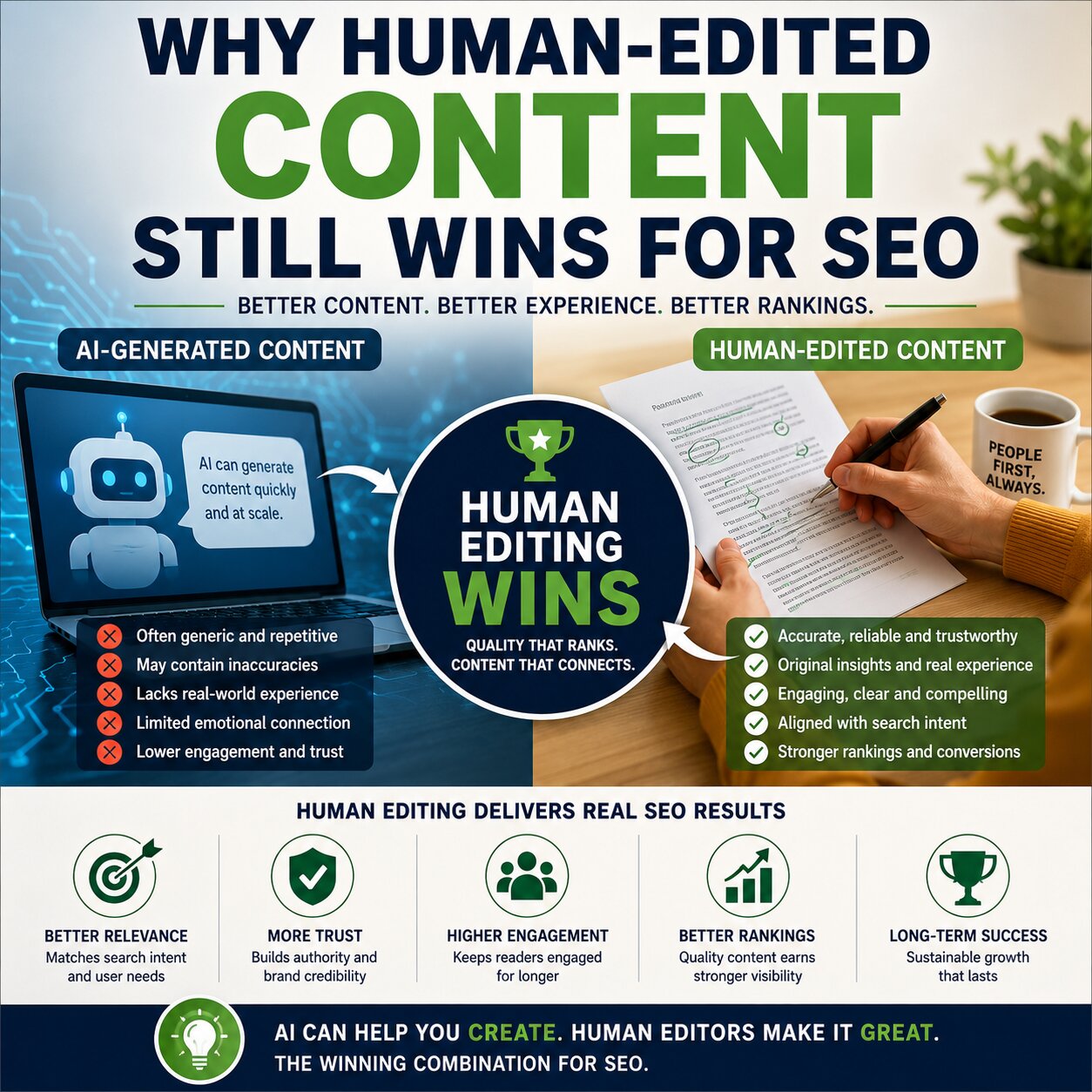
Artificial intelligence has transformed the content industry at an incredible pace. Businesses can now generate blog posts, product descriptions, website pages, and marketing copy in minutes instead of hours. While AI tools have improved productivity and accelerated content production, one reality remains clear in the SEO world: human-edited content still consistently performs better over time.
Search engines continue evolving toward prioritising quality, trust, user experience, and authentic expertise. This means that while AI-generated content can support workflows and assist with drafting, human editing remains essential for producing content that truly connects with readers and performs well in search results.
Search engines prioritise quality and experience

Modern SEO is no longer just about keywords and technical optimisation. Search engines increasingly evaluate content based on usefulness, expertise, originality, trustworthiness, readability, and overall user satisfaction.
AI can generate structurally correct content very quickly, but it often lacks nuance, context, emotional understanding, and real-world experience. Human-edited content helps bridge this gap by refining tone, improving clarity, correcting inaccuracies, and ensuring the content aligns with audience expectations.
Human-edited content also tends to provide stronger natural flow and storytelling. Readers engage more effectively with content that feels authentic and conversational rather than mechanically assembled. Engagement metrics such as time on page, bounce rate, and interaction levels all influence long-term SEO performance.
Search engines are becoming increasingly effective at identifying low-quality, repetitive, or generic AI-generated content. Human refinement helps transform raw drafts into valuable resources that offer unique insights and stronger user experiences.
Human editors improve accuracy and trust

One of the biggest weaknesses of AI-generated content is factual reliability. AI tools may occasionally generate outdated information, misleading statements, or incorrect details while presenting them confidently. This creates significant risks for brands, especially in industries requiring trust and expertise.
Human-edited content verifies facts, reviews sources, checks context, and ensures accuracy before publication. This editorial oversight is essential for maintaining credibility with both readers and search engines.
Trust signals are becoming increasingly important in SEO. Businesses that consistently publish reliable, well-structured, and authoritative content are more likely to build long-term search visibility and audience loyalty.
Human-edited content also helps align content with brand voice, company values, regional language preferences, and audience intent. AI often struggles to maintain a consistent personality and tone across large content strategies without careful human oversight.
Human creativity creates stronger engagement

SEO content is not only written for algorithms. It is written for people searching for answers, solutions, education, and emotional connection. Human creativity remains one of the strongest advantages in content marketing.
Editors and writers can inject personality, humour, emotional resonance, industry insight, and strategic storytelling into content. These elements make articles more memorable and shareable while improving reader trust and engagement.
Human-edited content also performs better when covering sensitive topics, localised contexts, opinion-based discussions, and complex industry insights. AI tools often produce overly safe or repetitive wording that lacks originality and depth.
Readers increasingly recognise when content feels generic or automated. Human refinement helps ensure content feels alive, purposeful, and genuinely valuable rather than mass-produced.
SEO requires strategy, not just content generation
Successful SEO content involves far more than generating large volumes of text. It requires strategic planning, search intent understanding, content architecture, internal linking, keyword integration, audience targeting, and conversion optimisation.
Human editors and SEO specialists understand how to structure content around business goals while balancing user experience and search engine visibility. They can identify opportunities AI may miss, such as:
- Search intent alignment
- Emotional engagement opportunities
- Content gaps and audience questions
- Internal linking strategies
- Conversion-focused sections
- Brand positioning improvements
- Regional language optimisation
- Content uniqueness and differentiation
AI can assist with speed and idea generation, but human expertise remains essential for turning content into a strategic asset rather than simply filling pages with words.
The future is AI-assisted, human-led content
The future of SEO content is unlikely to be fully human or fully AI-driven. Instead, the strongest approach combines AI efficiency with human expertise and editorial oversight.
AI tools can accelerate research, generate outlines, support brainstorming, and assist with first drafts. Human editors then shape the content into something accurate, engaging, strategically optimised, and aligned with real audience needs.
Businesses that rely entirely on unedited AI-generated content may initially produce high volumes, but long-term SEO performance often depends on quality, trust, and originality. Human editing helps protect brand authority while improving user satisfaction and search visibility.
As search engines continue refining how they evaluate content quality, businesses that invest in authentic, well-edited, audience-focused content will likely remain more competitive in organic search rankings.
The human touch still matters
Despite rapid advances in artificial intelligence, human-edited content continues to win because it delivers what audiences and search engines value most: trust, clarity, originality, relevance, and meaningful connection.
AI may help create faster workflows, but human insight transforms content into something readers actually want to engage with. In the evolving SEO landscape, the brands that balance technology with authentic human creativity will remain best positioned for long-term success.