
One of the most common questions businesses and website owners ask is how long their content should be for SEO. While there is no universal word count guaranteed to rank on Google, content length still plays an important role in search visibility, user engagement, and topical authority.
Some articles rank well with only a few hundred words, while others require thousands of words to properly answer user intent. The ideal content length depends on the topic, competition, search intent, and the depth of information required to satisfy readers.
Understanding how content length influences SEO can help businesses create stronger articles, blog posts, landing pages, and guides that perform better in search engines.
Why content length matters for SEO

Longer content often performs better in search results because it provides more opportunities to answer questions, target related keywords, and cover a topic comprehensively.
Search engines aim to deliver the most useful and relevant content to users. Articles that fully explain a topic usually generate longer engagement times, more backlinks, and better user satisfaction signals.
However, length alone does not guarantee rankings. Thin content padded with unnecessary filler can actually harm readability and user experience.
The goal should always be to create valuable content that satisfies search intent while naturally covering the subject in enough depth to compete with existing ranking pages.
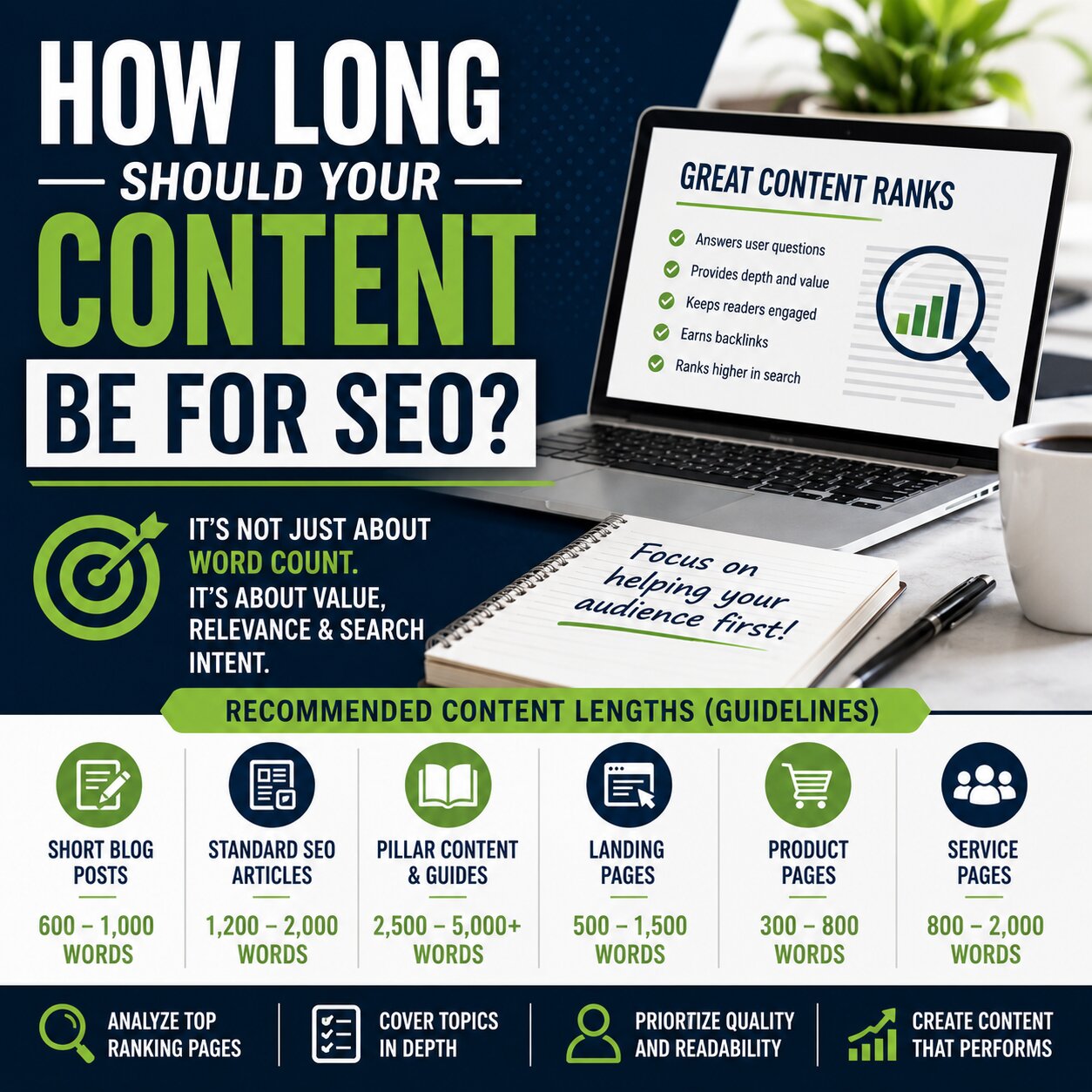
Recommended content lengths for different content types

Different types of content usually require different word count ranges depending on their purpose and audience expectations.
Here are some general SEO content length guidelines:
- Short blog posts: 600 to 1,000 words
- Standard SEO articles: 1,200 to 2,000 words
- Pillar content and guides: 2,500 to 5,000+ words
- Landing pages: 500 to 1,500 words
- Product pages: 300 to 800 words
- Service pages: 800 to 2,000 words
These ranges are not strict rules but rather starting points based on common SEO performance trends across industries.
Highly competitive keywords often require more comprehensive content because competing pages are already covering the topic in great detail.
Search intent matters more than word count
One of the biggest SEO mistakes businesses make is writing toward a target word count instead of focusing on user intent.
If someone searches for a quick factual answer, a short and direct article may perform better than a lengthy guide. On the other hand, educational topics or complex buying decisions often require much deeper content.
Google increasingly evaluates how effectively content solves the user’s problem rather than simply counting words. A shorter article that clearly answers the query can outperform longer content filled with repetition or irrelevant information.
This is why research remains critical before creating content. Analysing the top-ranking pages for a keyword helps determine the level of depth users and search engines expect.
Quality and structure still come first

Even the longest article will struggle to rank if it lacks structure, readability, or useful information. Content quality always matters more than simply increasing word count.
Strong SEO content should include clear headings, logical flow, readable paragraphs, relevant keywords, internal linking opportunities, and engaging information that keeps readers interested.
Well-structured content also improves user experience by making it easier for readers to scan and find important information quickly. This can improve engagement metrics and reduce bounce rates.
Instead of obsessing over exact word counts, businesses should focus on creating content that fully addresses the topic while remaining valuable, clear, and enjoyable to read.
Creating content that satisfies both readers and search engines
The best SEO content balances depth, quality, readability, and user intent rather than chasing arbitrary word count targets.
Some topics naturally require extensive detail, while others work better with concise explanations. Understanding the needs of your audience is far more important than trying to hit a specific number of words.
By focusing on relevance, structure, and helpful information, businesses can create content that performs well in search results while building trust and authority with readers over time.
In the end, the ideal content length for SEO is simply the length required to answer the user’s question better than competing pages.