
Understanding why most business websites fail is the first step toward building one that actually delivers results. Many companies invest time and money into design, development, and branding, only to see little to no return from their online presence.
The problem is rarely the platform or the visuals. More often, it comes down to messaging, structure, and how well the site communicates with its audience. This is where content plays a critical role.
In this guide, we explore why most business websites fail and how strategic content can turn things around.
The Real Reasons Most Business Websites Fail

When analysing why most business websites fail, several common issues stand out. These problems often go unnoticed but have a significant impact on performance.
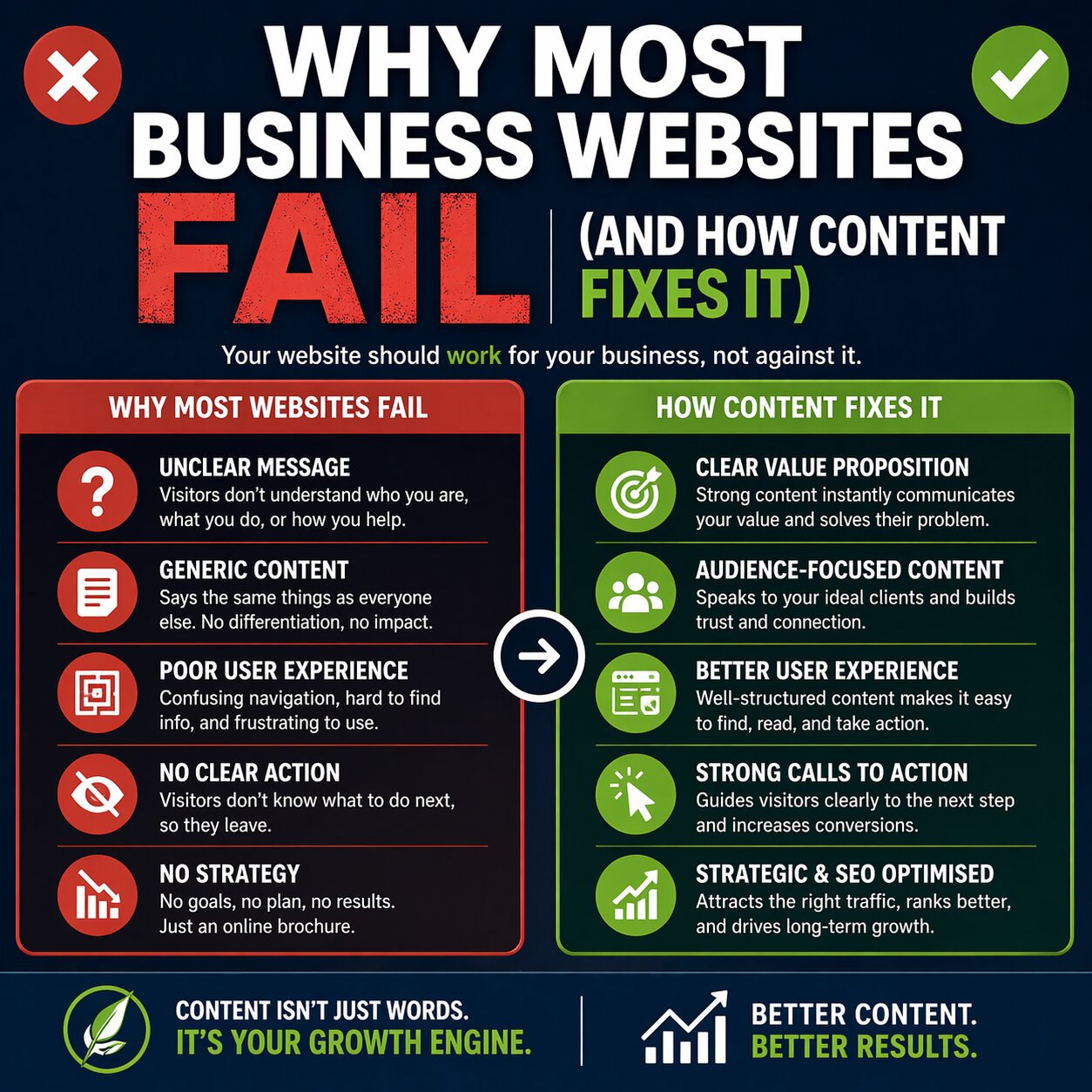
Many websites lack clear messaging. Visitors arrive and quickly leave because they do not understand what the business offers or how it can help them. Confusion leads to lost opportunities.
Another issue is weak or generic content. If your website says the same thing as every competitor, there is no reason for visitors to choose you. Without differentiation, your site blends into the background.
Poor structure is also a major factor. If users cannot easily find what they are looking for, they will leave. Navigation and content flow must guide visitors naturally through the site.
These are the core reasons why most business websites fail, and they all point back to one thing: ineffective content.
Lack of Strategy and Purpose

A major reason why most business websites fail is the absence of a clear strategy. Many businesses create websites without defining their goals or understanding their audience.
Without a clear purpose, content becomes scattered and unfocused. Pages exist, but they do not work together to guide visitors toward a specific outcome.
Effective websites are built around a strategy. Every page, section, and piece of content serves a role in the customer journey. From awareness to conversion, each step is intentional.
When businesses ignore this, their websites become digital brochures rather than powerful marketing tools.
How Content Drives Engagement and Trust
Content is the foundation of a successful website. When addressing why most business websites fail, strong content is often the missing piece.
High-quality content answers questions, solves problems, and builds trust with your audience. It shows that you understand their needs and have the expertise to help.
Clear, well-written content also improves user experience. Visitors can quickly understand your value and decide whether to take the next step.
In addition, content plays a key role in search visibility. By targeting relevant keywords and providing valuable information, your website becomes easier to find online.
This is how content directly addresses why most business websites fail and turns them into effective platforms.
Key Content Fixes That Make a Difference

To overcome why most business websites fail, businesses need to focus on improving their content strategy. Here are some essential fixes:
- Clear value proposition that immediately explains what you offer
- Audience-focused messaging that speaks directly to your target market
- Strong calls to action that guide users toward the next step
- Structured content flow that improves navigation and readability
- SEO optimisation to increase visibility and traffic
These changes may seem simple, but they have a powerful impact on performance. They transform your website from passive to active.
By implementing these fixes, you address the root causes of why most business websites fail.
Turning Your Website Into a Conversion Tool

A successful website does more than just exist. It actively works to convert visitors into customers. This is where content becomes a strategic asset.
Instead of focusing only on design, businesses should prioritise how their message is delivered. Content should guide users, answer objections, and build confidence.
Every page should have a purpose. Whether it is informing, engaging, or converting, content must move visitors forward in their journey.
When done correctly, your website becomes a powerful tool for growth rather than a static online presence.
Build a Website That Works
Why most business websites fail is not a mystery. It comes down to unclear messaging, lack of strategy, and ineffective content.
The good news is that these issues can be fixed. By focusing on strong, strategic content, businesses can transform their websites into high-performing assets.
If you want a website that attracts, engages, and converts, content is the key. It is not just about what your site looks like, but how it communicates.
If your website is not delivering results, it may be time to rethink your content strategy and build something that truly works.